Wednesday, October 26, 2011

Stellar Soundtracks: Amar Akbar Anthony


In June 1975 Indira Gandhi declared India to be in need of Emergency administration. Predictably, thousands were arrested, press freedoms were done away with, political parties banned and Congress goondas presided over a new political dispensation based on fear, sloganeering and forced social engineering. All completely anathema to most Indians up until that point.

The next two years were dark. The Emergency divided the country and tainted public figures for years to come. The Nehru family’s reputation and that of the Congress Party were damaged forever.

But then in 1977 in a fit of self-deception typical of all autocrats Indira decided she’d like to bask in the love of her ‘disciplined’ people and called them to the polls to vote her in again.  Well, being very naughty children, they grabbed the opportunity and threw her out.

What a day of rejoicing that was. I was too young to experience Independence but the relief and hope and joy I felt when I showed up in Delhi a couple months after she’d been tossed out must have been something like what an older generation felt when the Brits were finally sent packing in 1947.

The big blockbuster of Bombay in 1977, that year of India’s second Independence, was a romping comedic melodrama called Amar, Akbar, Anthony, a film film about three brothers separated during their childhood who grew up in three different homes, adopting three different religions.

Kishanlal (Pran), a chauffeur, takes the blame for a fatal hit-and-run accident committed by his mob boss employer, Robert (Jeevan), on the assurance that his family's income will be tripled and their welfare looked after. He returns from prison to find his wife Bharati (Nirupa Roy) suffering from tuberculosis and his three sons starving. Seeking help from Robert for the sake of his family, he is ridiculed, humiliated and repudiated, until he turns on Robert and tries to kill him. Making his escape, Kishanlal inadvertently takes a car containing a shipment of gold bullion. Robert's goons give chase.
Kishanlal goes home to rescue his family - only to find his wife's suicide note. Unbeknown to him she fails, and is struck blind. He leaves his sons in a public park (at the foot of a statue of Gandhi) while he draws off the pursuing goons. In the car chase that follows he crashes, is thrown clear of the wreck, and discovers the gold. But by the time he returns to the park with his riches, his three children have vanished. Amar, the oldest, has been adopted by a Hindu policeman; a Muslim tailor adopts the youngest and names him Akbar, and a Catholic priest, finding the middle son asleep on the steps of his church, fosters him and names him Anthony.
In revenge, Kishanlal kidnaps Robert's daughter Jenny and raises her as his niece, using the gold to destroy Robert's business and set himself up as mob boss instead.
Amar (Vinod Khanna) becomes a policeman like his adoptive father; the Muslim Akbar (Rishi Kapoor) becomes a singer; the middle brother, Anthony (Amitabh Bachchan), becomes a likable, socially-conscious Catholic scamp who runs quasi-legal operations and makes God his 'partner' by donating half his income to charity. The three meet when they donate blood for an accident victim, unaware that they are related - or that the recipient is actually their biological mother Bharati.
Their lives become entangled in an incredible web of coincidences and furious action sequences - interspersed with songs - when Amar's adopted father is seriously wounded and Anthony falls in love with Jenny, Robert's long-lost daughter. Because of it his adoptive father, the priest, is murdered. In their pursuit of justice their paths cross again until, combining efforts, the three brothers discover both the culprit and their mutual heritage.
In addition to the ongoing feud between Robert and Kishanlal, each son meets and courts - with greater or lesser difficulty - their love interests. When the grieving mother regains her sight at a Dewali festival in honor of Sai Baba, one by one the family is re-united and Robert, who caused their suffering, is finally imprisoned. (Wikipedia))

The movie starred three of the biggest leading men of the day, including the mighty Amitabh Bachchan, who was at the very peak of his powers at this stage. He didn’t make many flops in the mid-70s, and this film went on to win many Filmfare Awards (Indian equivalent of the Academy Awards) including Best Actor (Bachchan) and Best Music Director (Laxmikant-Pyarelal).

The janata (public) rushed to the cinemas in record numbers because Amar Akbar Anthony was the perfect celluloid antidote to what had just hit the country.  After 2 years of stern government finger wagging and sloganeering (Less talk, more work! Discipline is the key to greatness!) here was three hours of silliness, farce and misadventure served up in great splashes of colour. Oh how drab the Emergency had been by contrast.

And if Indira and her tragic son, Sanjay, had driven a rift deep into Indian society by putting everyone on edge and dividing the country into hateful camps, the movie scooped up Indians of all types (Muslims, Hindus, Christians) in a wild embrace and said, “We’re all a part of the same family!  The one for whom we have given our blood is our mother, India.”

It was intoxicating to watch that movie that year. I saw it in Mussoorie with some friends and it was the one we kept talking about the rest of the year.  And kept singing the songs.  The soundtrack, featured here tonight, is one of the most popular and includes the voices of Mohammad Rafi and Kishore Kumar the twin titans of playback.

Every religious community got something it could hum along to. Muslims got one of the most famous film qawwalis Pardah hai pardah. Hindus got Shirdiwale Sai Baba (a paean to India’s modern guru of religious unity). Christians got Amitabh Bachchan popping out of birthday cake spouting outrageous non sequiturs such as “The whole country of the system is juxtapositioned by the hemaglobin in the atmosphere because you are a sophisticated rhetorician intoxicated by the exuberance of your own  vivacity!”. The song was called My Name is Anthony Gonsalves.

Altogether a riot of fun, hilarity and incredible coincidence. 


         Track Listing:
01. Amar Akbar Anthony
02. Hum ko ho Gaya Pyar
03. Tayab Ali Pyar ka Dushman
04. Pardah hai Pardah
05. Shirdi Wale Sai Baba
06. My Name is Anthony Gonsalves
Extra bonus track:
07 Dialouge: A drunken Anthony (Amitabh Bachchan) talks to himself in the mirror  

Listen here.

P.S.
Anthony Gonsalves, the character played by Amitabh Bachchan, is a real man. He was the violin teacher of the film’s music comper Pyarelal, one of the many Goan master musicians who have played such a HUGE but unheralded part in the success of Bollywood music over the decades.  A fantastic website called Tajmahal Foxtrot tracks the history of all little known corners of Indian jazz and music and has an absolutely unforgettable article about Mr Gonsalves for those interested.  Indeed, spend many hours on Naresh’s website…it is true treasure.


Tuesday, October 25, 2011

61 Years Old Today: Tom Waits


Tom Waits is 61 years old today.

What does a man want more than to have a bunch of women sing his praises?

This collection shows what a fantastic songwriter Tom is and how ‘feminine’ his song writing is.  So many of his songs have such strong women characters in them. Or somehow have the hovering presence of a woman in them. Love stories, troubled love stories, searching love stories, road love stories.

This collection is great also because it covers the waterfront of styles, demonstrating how versatile his songs are. About the one place they don’t fit is in a 80’s stadium rock (Patty Smyth’s version of Downtown Train is a shocker).
Tom Waits

So happy birthday Thomas. From some of the best lady singers in the world!


         Track Listing:
         Disc One.
         01 Blow Wind Blow  Astrid Seriese
02 Diamonds And Gold The Silver Hearts
03 November  Liz Durrett
04 Diamonds And Gold  Aileen Loy and the Blue Valentines
05 Anywhere I Lay My Head Anna Ternheim
06 Downtown Train Patty Smyth
07 Earth Died Screaming Tracy Bonham
08 Strange Weather Marianne Faithfull
09 Christmas Card From a Hooker In Minneapolis  Neko Case
10 Day After Tomorrow  Joan Baez
11 Another Man's Vine.mp3
12 Green Grass  Cibelle
13 Big In Japan Aileen Loy and Blue Valentines
14 Jockey Full Of Bourbon Meret Becker and Ars Vitalis
15 Please Call Me, Baby Sally Norvell
16 Broken Bicycles Christine Collister
17 29 Dollari (e una borsetta di coccodrillo) Laura Fedele
18 Chocolate Jesus Janelle Lauer
19 Fumblin' With The Blues Claudia Bettanaglio
20 Anywhere I Lay My Head Sista Spooky

Listen here.

         Track Listing:
         Disc Two.
         01 Temptation Diana Krall
02 Tom Traubert's Blues  Maria Joao and Mario Laginha
03 Yesterday Is Here  Cat Power
04 Temptation  Clara Bakker
05 Come On Up To The House Owilde
06 Jersey Girl  Holly Cole
07 It's Over Vamosbabe and Pascal Fricke
08 Underground Astrid Seriese
09 The Heart Of Saturday Night Diana Krall
10 I Hope That I Don't Fall In Love With You Olivia Gale
11 Ol' 55 Sarah McLachlan
12 Tango Till They're Sore Holly Cole
13 Day After Tomorrow Linda Thompson
14 Long Way Home Norah Jones
15 Poncho's Lament The Blacks
16 Ol' '55  Lisa Bassenge Trio
17 Muriel Eleni Mandell
18 I Hope That I Don't Fall In Love With You Priscilla Herdman
19 Ruby's Arms Megan Mullalhy
20 Sea Of Love  Cat Power

Listen here.


Friday, October 21, 2011

Friday Night Special (LInk now Fixed)


It’s Friday night. Which is sort of special. After an amazingly HEAVY week the tunnel is a bit more light. And so the first of a soon to be regular (or semi regular) Friday Night Specials.

In India and Pakistan they say shabaash in the same way the Spaniards say bravo!

A collection of great songs from all over the world, no theme, no geographic unity, just songs you want to say shabaash to.


            Track Listing:
01.  Aaj ki Raat  Asha Bhosle  (Asha does her best Glenn Close impression)

02.  Abasi Do   Black Beats Band (Vintage trumpet led Ghanian highlife ca. 1960)


03.  Africa Obata  Pierre Akendengue (Funk de la Gabon in French Central Africa)

04.  All My Mistakes  Avett Brothers (A bit of tongue in cheek confessions from the Carolinas)


05.   Allah Karyo Karo  Tahira Syed (Sufiana plea for Allah’s blessing from one of many Pakistani divas)

06.  Amargado  Duo Los Ahijados (Dominican son)


07.  Ass'ada' illahou Masa'akom   Salma (Lebanese jazz)

08.  Blowin' In The Wind  Ben Sidran  (Classic Dylan done stately)


09.   Born On The Bayou  X-lents (Classic CCR served by Indian garage band from 1970)

10.  Bukom Mashie   Oscar Sulley (Funk. Ghana. Dance)


11.  Business Time  Flight of the Conchords (Barry White was really from suburban New Zealand)

12.  Chal Chal Mere Bhai (Naseeb)  Mohammad Rafi (Tripping home after too much to drink at the cinema)


13.  Chewing Gum Lips   Usha Uthup (India’s versatile pop queen blows some bubbles)

14.  Chhalla  Rabbi Shergill (Soulful Punjabi pop)


15.  Chumma Chumma  New Bharat Brass Band (Number 1 Indian wedding song played by Number 1 wedding band)

16.  Coline's Rose (For Coline And Robbie) Kyle Shepherd (Piano jazz beauty from South Africa)


17.  Curt Flood  Joe Henry (Homage to baseball hero of years gone by)

18.  Dap Walk Ernie & the Top Notes (Crescent City. Funky as always)


19.  Deep Seas (chilly desert mix) Dub Corporation (Chill out by the sea)

20.  Dhow Countries Taj Mahal (Souvenir from his visit to Zanzibar)


21.  Diaraby Magni  Vieux Farke Toure (Ali’s son shows its in the genes)

22.  Dimples  James Blood Ulmer (John Lee Hooker revisited)


23.  Diougou diougou Orchestre Boabab (Gentle interlude from Senegal’s greatest band)

24.  Dizani Wa Arif Madami   Ilham Madfai (Celebrating Qadafi’s demise perhaps?)


25.  Do Right To me Baby (Do Unto Others)  Bob Dylan (Preachin’ and reachin’ for love)

Listen here.

Thursday, October 20, 2011

Music for Harmonious Living: Veena Chitti Babu

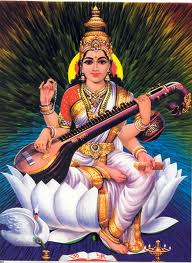
Saraswati


Saraswati is the Goddess of leaming, knowledge, and wisdom. The Sanskrit word sara means "essence" and swa means "self." Thus Saraswati means "the essence of the self." Saraswati is represented in Hindu mythology as the divine consort of Lord Brahma, the Creator of the universe. Since knowledge is necessary for creation, Saraswati symbolizes the creative power of Brahma. Goddess Saraswati is worshipped by all persons interested in knowledge, especially students, teachers, scholars, and scientists.

In Her popular images and pictures, Goddess Saraswati is generally depicted with four arms (some pictures may show only two arms), wearing a white sari and seated on a white lotus. She holds a book and a rosary in Her rear two hands, while the front two hands are engaged in the playing of a veena. Her right leg is shown slightly pushing against Her left leg. She uses a swan as Her vehicle. There is a peacock by Her side gazing at Her.

The musical instrument in her hands, the veena denotes mind and intellect. This symbol conveys that the seeker must tune his mind and intellect in order to live in perfect harmony with the world. Such harmonious living enables the individual to utilize acquired knowledge for the welfare of all mankind.

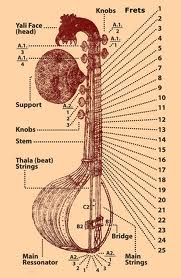
The Saraswati veena (also spelled Saraswati vina) is an Indian plucked string instrument. It is named after the Hindu goddess Saraswati, who is usually depicted holding or playing the instrument. s used mostly in Carnatic Indian classical music. There are several variations of the veena, which in its South Indian form is a member of the lute family. One who plays the veena is referred to as a vainika.


The veena is an ancient instrument dating back to Vedic times (1500BCE). The veena instruments developed much like a tree, branching out into instruments as diverse as the exotic harp-like Akasa (a veena that was tied up in the tops of trees for the strings to vibrate from the currents of wind) and the Audumbari veena (played as an accompaniment by the wives of Vedic priests as they chanted during ceremonial Yajnas). Veenas ranged from one string to one hundred, and were composed of many different materials like eagle bone, bamboo, wood and coconut shells.

The current form of the Saraswati veena with 24 fixed frets evolved in Thanjavur, Tamil Nadu, during the reign of Raghunath Nayak and it is for this reason sometimes called the Tanjore veena, or the Raghunatha veena. Prior to his time, the number of frets on the veena were less and also movable.

The veena is played by sitting cross-legged with the instrument held tilted slightly away from the player. The small gourd on the left rests on the player's left thigh, the left arm passing beneath the neck with the hand curving up and around so that the fingers rest upon the frets. The palm of the right hand rests on the edge of the top plank so that the fingers (usually index and middle) can pluck the strings. The drone strings are played with the little finger. The veena's large resonator is placed on the floor, beyond the right thigh. (Wikipedia)
Like the sitar, the left hand technique involves playing on the frets, controlled pushing on the strings to achieve higher tones and glissandi through increased tension, and finger flicks, all reflecting the characteristics of various ragas and their ornamentation (gamaka). Modern innovations include one or two circular sound holes (like that of the lute), substitution of machine heads for wooden pegs for easier tuning, and the widespread use of transducers for amplification in performance.

Chitti Babu (1936-1996) was one of the most famous Veena artistes of India, who had carved his place amongst the all-time greats who played that instrument. A man who became a Legend in his own Lifetime, his name was synonymous with the instrument "Veena", and he was and is still known in the Carnatic music world, quite simply as “Veena” Chitti Babu. While continuing with the principles of his Guru’s pioneering school - the Emani “Bani” (tradition/style), Chitti Babu, created and evolved a distinctive style and identity, entirely his own. The exquisite tonal quality and versatility that have been his magical hallmarks of his style of playing the Veena, saw him produce sounds as varied as the majestic Vedic Hymns or as delicate as the Cuckoo’s voice or even play many western-music based compositions of his own. He was known to reproduce the songs and compositions in an almost vocal like tonal quality on his Veena, and was also known to evoke deeply emotional and appreciative responses from his audiences. (http://www.veenachittibabu.org/id1.html)


More scintillating music from India.


         Track Listing:
01 Chalamela, Sudhamayi, Ksheera Sagara Sayana
02 Ragam Thanam Pallavi, Apadooruku, Nallani Vada, Mangalam (A Hymn from Vedas)
Listen here.