Showing posts with label Cuba. Show all posts

Friday, March 22, 2013

Friday Night at the Tropicana: Generoso 'Tojo' Jimenez


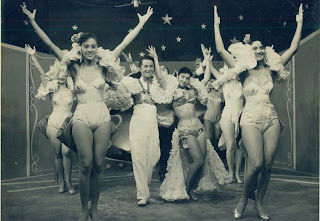
Havana, Cuba was Sin City for many Americans for the first half of the 20th century. Sugar barons, gangsters, dancing girls and spies haunted the clubs and bars along the the water front.  They say there were more Cadillacs per capita in Havana then anywhere else on earth. Night spots like Sloppy Joe’s, Floridita and the Tropicana were household names even in small town America.  The good times rolled faster and longer in Cuba than anywhere else in the world. It was a hoot, 24 hours a day.

And when it came to music Cuba gave the world the rumba, the chacha, son and all sorts of jazzy cocktails.  Music was everywhere. In the 5 Stars as well as in the dives. In the churches and in the streets.  Just as America was making Havana into its own little naughty off-shore play land, Generoso Jimenez, was born in Ceinfuegos, a town famous for producing numerous famous musicians.

He studied music with his father as a young boy and chose the slide trombone as his weapon of choice when he joined the local municipal band. He began developing his unique style in those early years because, the touring brass bands he played in had few trumpeters and it was left to the trombonists to do something ‘interesting’ during the breaks.

In Cuba all roads lead to Havana and soon Jimenez was playing the ‘bone in The Tropicana. The top shelf of American crooners--Sinatra, Nat King Cole, Cab Calloway--were regular performers and Generoso was always in the show band.  After hours he was a regular part of the jam sessions that could be found all over the city.  In the early 1950’s he joined a new band which was performing a new crazy rhythm called batanga, in which a new (to Cuba, if not to Latin America) vocalist named Beny More was the lead singer.  The following year, 1953, More, undoubtedly Cuba’s greatest singer, asked Jimenez, to manage his huge band as well as be the main music arranger.  In later years, he led the band for sometime before making his own records, two of which are highlighted tonight.


This release contains two sessions from the orchestra of Generoso Jimenez recorded several years apart. The first album [tracks 13-23] was recorded in 1960. [The record] includes exquisite versions of of such outstanding songs as Tono Fuentes’ Colombian ‘porro’ La mucura, performed ..in the Cuban guaracha style with some tasty grooves from the saxophone section and a magnificent solo by Chocolate Armenteros

Although Ramon Cabrera’s son A la Bahia de Manzanillo, was immortalized by Beny More, this instrumental mambo version gives the singer’s classic interpretation a run for its money with an exciting trumpet, trombone and sax duel.

This release, originally titled as Ritmo, includes first rate versions of La bamba with its typical rhythm from Vera Cruz; the rumba Senorita Luna with a loose arrangement; the Italian song Come prima, heard here in Havana’s cha cha cha style and many others.

The second session [tracks 1-12] was recorded in 1965 with another brilliant band. The first track is non other than the outstanding descarga (improvised jam based on a Cuban song) composed by Generoso and Rolando Baro entitled Trombon majadero. This is followed by the track  Descarga solfeando, another jam by the trombonist,  which contains a humorous interlude imitating a solfege lesson in the middle of the song. (Liner notes)

I’ve always been a sucker for good trombone playing and so commend these two classic Cuban jazz albums to you this Friday evening.

The sound of pre-revolutionary Havana!

Track Listing:
1-01 Trombón Majadero (Descarga)
1-02 Descarga Solfeando (Descarga)
1-03 Jaky Ky (Descarga)
1-04 La Rosa Roja (Chachachá)
1-05 Las Pilanderas (Descarga)
1-06 Ya No Me Quieres (Bolero)
1-07 Garabato (Descarga)
1-08 El Torrente (Mambo Chá)
1-09 La Vieja Rosa (Descarga)
1-10 Uno, Dos y Tres (Conga)
1-11 Llegaron del Otro Mundo (Descarga)
1-12 El Contrabajo Fantasma (Descarga)


2-01 La Bella Cubana (Chachachá) [feat. Cachao]
2-02 Come Prima (Chachachá) [feat. Cachao]
2-03 La Múcura (Guaracha Porro) (Featuring Cachao)
2-04 A la Bahía de Manzanillo (Son Mambo) [feat. Cachao]
2-05 Sueño de Amor (Chachachá) [feat. Cachao]
2-06 Cachita (Rumba) [feat. Cachao]
2-07 La Bamba (Bamba) [feat. Cachao]
2-08 Señorita Luna (Rumba) [feat. Cachao]
2-09 Besitos de Coco (Merengue) [feat. Cachao]
2-10 El Tambor de la Alegría (Tamborito) [feat. Cachao]
2-11 Maracaibo Oriental (Son Montuno) [feat. Cachao]


Saturday, May 12, 2012

Twin Bones: Juan Pablo Torres and J.J. Johnson


The only thing that ultimately matters is to eat an ice-cream cone, play a slide trombone, plant a small tree, good God, now you're free.
Ray Manzarek

Even though I played trumpet for a while as a young buck I find very little to disagree with in the Doors’ keyboardist’s summation of freedom.

The mellow, burnished tone of the trombone is among my favorite sounds in the universe. And to end the week here are two fine albums by a pair of blue ribbon trombonists: Juan Pablo Torres, the Cuban, and J. J. Johnson, the greatest of all bone players.

Juan Pablo Torres

AfroCuban Trombone
Torres always puts out good records, and he's outdone himself this time, producing a masterpiece. Like a handful of other Cuban musicians Torres has begun to reexamine the history of Cuban music instead of just play it. So on a bunch of the tracks here the music is played by a saxophone quartet, with the bass role taken by a tuba. Some of the tunes have percussion and drums, others are a wind choir, and the simple process of arranging the music for the group takes it out of the ordinary. Other tracks have the extraordinary rhythm section of Jorge Reyes on bass and Enrique Pla on drums; it's modern Latin jazz at its best. Torres plays a ton of trombone, and he's joined in the front line by Irvin Acao, a tenor player who could hang in New York. The two of them bring so much to the music, it's like having a dictionary of American and Cuban musical practice, all explained by gifted conversationalists. (http://www.descarga.com/cgi-bin/db/19865.10)
        

         Track Listing:
         01 Afroidea
02 4 x 4
03 Lamento Montuno
04 Rumba Pa los Trombones
05 Ensalada De Mambo
06 Canuto
07 Trommontuno
08 Contrapunto
09 Cubachando
10 Montunostring

J.J. Johnson
Proof Positive
This CD reissue finds trombonist J.J. Johnson in prime form. In fact, his melancholy minor-toned explorations often recall Miles Davis, whose group he had played with the year before). Backed on six of the seven tracks by pianist Harold Mabern, who at the time was heavily influenced by McCoy Tyner, bassist Arthur Harper and drummer Frank Gant, Johnson gets to really stretch out on "Neo," "Minor Blues" and "Blues Waltz"; "Gloria" was previously available only on an Impulse sampler. Manny Albam's "Lullaby of Jazzland," on which Johnson is joined by guitarist Toots Thielemans, pianist McCoy Tyner, bassist Richard Davis and drummer Elvin Jones, rounds out the excellent set.


         Track Listing:
         01 Neo
02 Gloria
03 Stella By Starlight
04 Minor Blues
05 My Funny Valentine
06 Blues Waltz
07 Lullaby Of Jazzland


Tuesday, November 8, 2011

French and Spanish: Music from the Caribbean


Two favorites tonight. One recent and one old. Both from the Caribbean a region of the world I’ve never spent time but where music is fresh and exhilarating.

Lilting biguines, heavy gwo ka drums and tumbélé rhythms collide with the sounds of the carnival. Haitian, Congolese and Puerto Rican influences are added to the pot in a percussive celebration of Afro-Caribbean spirit.
Martinique and Guadeloupe are overseas départements of France, situated in the Eastern Caribbean island chain of the Lesser Antilles. Successive waves of immigrants and a strong French colonial presence have combined to produce a strong musical culture that takes in African and latin rhythms alongside Jazz, calypso and the local biguine style.
Often overlooked in the English speaking Caribbean, the scattering drums and soaring clarinets of the biguine ruled the airwaves and dancefloors of Martinique and Guadeloupe in the 1960s.
This album showcases the vibrancy of the scene on the islands in the ‘60s and ‘70s – a scene that would go on to develop the all-conquering sound of zouk in the ‘80s. Uptown bands like Ensemble La Perfecta and Les Loups Noirs combine heavy rhythms and psychedelic effects in an inimitable style – check out the crazed Jet Biguine for a better idea! The deep and introspective sounds of Monsieur Dolor and Guadeloupean hero Robert Loison show the deep African roots of the music – songs born out of the plantations, with an insistent rhythm and mournful vocals that are unique to these islands.
Overlooked outside of Paris, Montreal and the French Caribbean for many years, this collection redresses the balance by presenting the vital sounds of Martinique and Guadeloupe – missing pieces of the musical jigsaw puzzle of the Caribbean.

This is really exciting fast moving dance music. Unfortunately, as one listens to it one is filled with regret that these small musical islands are so blasted far away from the neighborhood.


            Track Listing:
01   Jeunesse Vauclin – Barel Coppet et Mister Lof

02   Jet Biguine – Les Loups Noirs D’Haïti
03   Pas O Soué La – Abel Zénon
04   Manzè Mona – Raphaël Zachille
05   Henri Te Vlé Mayé – Robert Mavounsy Quartet
06   
La Vie Critique – L’Orchestre Jeunesse de Paul-Emile Haliar

07   Mussieu A Têt’a Poisson La – Orchestre Combo Zombi et Michel Yéyé
08   
Oriza – Les Kings
09   
Colas-la – Claude Rolcin et Le West Indian Combo
10   Ti Fi La Ou Té Madam’ – Anzala, Dolor, Vélo
11   D’Leau Coco – Les Leopards

12   Jojo – Ensemble La Perfecta

13   Dima Bolane – Le Ry-co Jazz

14   Edamise Oh! – Lola Martin
15   Chombo Meringue – Les Aiglons de Basse Terre
16   Son Tambou La – Les Gentlemens
17   Chonga – L’Ensemble Abricot

18   Fileo – Francisco

19   Panty – Monsieur Dolor et Les Guitar Boys
20   Jean Fouillé, Pie Fouillé – Robert Loison

Listen here.

A part of the world I have had the privilege of working in is Angola which throughout its 25 years of civil war was supported by Cuban troops and doctors.  When I was there Angolans were ambivalent about the value the Cuban soldiers had added to their country. But I never met one Angolan who had anything but awed respect and praise for the dedication of the thousands of Cuban doctors and medical staff who worked throughout the country in shocking conditions and on very low wages. 

The experience obviously made an impression on the Cubans themselves, as is heard in the song De Kabinda a Kunene Un Solo Pueblo (The Only Person from Kabinda to Kunene) on the collection of Cuban music Sabroso! Havana Hits. The song is a humorous musing of a Cuban (Doctor perhaps?) who is stuck alone in the vastness of Angolan landscape.

All the songs on this record are similar but very different from those of the French Caribbean and make a nice complement to Tumbele!


            Track Listing:
            01 A Los Rumberos De Belen - Grupo Sierra Maestra
02 Camina Y Ven - Celina Gonzalez
03 El Son De Nicaragua - Orquestra Chepin
04 Rucu Rucu A Santa Clara - Grupo Irakere
05 Chilindron De Chivo - Conjunto Casino
06 De Kabinde A Kunene Un Solo Pueblo - Conjunto Los Karachi
07Anda Ven Y Muevete  - Orquestra Los Van Van
08 Vuela La Paloma - Conjunto Rumbavana
09 Se Que Tu Sabes Que Yo Se - Orquestra Revé
10 Frutas Del Caney Grupo Monumental

Listen here