Showing posts with label Veena Chitti Babu. Show all posts

Friday, March 8, 2013

Of Prophets and Disciples: Bill 'Ravi' Harris and Chitti Babu


Oh, East is East, and West is West, and never the two shall meet,

Till Earth and Sky stand presently at God’s great Judgment Seat;

But there is neither East nor West, Border, nor Breed, nor Birth,

When two strong men stand face to face, tho’ they come from the ends of the earth.
[Rudyard Kipling]

Say what you will about the imperialistic, macho poetry of the British Raj’s great apologist, but buried within the sentiment, faux-chivalry and smugness lay some cracking lyrics. The one that opens tonight’s post is not necessarily the best of Kipling’s nuggets but it is, arguably, the most widely quoted.

And in some weird way it encapsulates the purpose of this early, hot, autumn Friday evening post. East and West try to meet. Two strong men (with their retinues of Prophets and Disciples) stand face to face, ready to do battle. Not with sabres or bandooks but armed with sitar and veena.  

The Washerman’s Dog will leave to you to pronounce judgment whether either of these men have been able to prove Kipling wrong and blend East and West.

Bill ‘Ravi’ Harris has a day job. He produces very groovy R&B records for the likes of Sharon Jones and the Daptones on his Daptone Records label. As a teenager Gabriel Roth (Bill’s day-job name) had two loves: James Brown and the sitar.  The combination was bound to end in trouble one day. And that day resulted in a weirdly wonderful recording called, not unexpectedly, Funky Sitar Man. With a couple of Hindu erotic sculptures (could be from Khajuraho) swinging their hips on the cover, Harris gets encouragement for his sitar-funk curry from a couple of Prophets: Mike Wagner on bass and on drums, Philippe Lehman.

The record covers songs by Harris’s hero James Brown, The JBs and a very cool version of the original Afro-funk hit, Soul Makossa.  I’ve heard many attempts to fuse the sitar with Western music but never did I think I’d be tapping my foot to Sex Machine!  

Sounds like a novelty and I suppose in some sense, the record is. Certainly, its a bit of personal indulgence; Harris is having fun for sure.  But put all that aside, the music is good. While he’s no Ravi Shankar, his sitar playing is not at all bad, and with the Prophets providing a funky rhythm, the overall sound is very much worth repeated listens.

Funky is not a word normally associated with the ancient Indian instrument, the veena. But Telegu musician, Chitti Babu, is certainly nothing if not cheeky. Famous for being one of India’s most talented veena players, he also had a knack for making records with wild, rather contextually inappropriate covers.  Indeed, it was the cover of tonight’s second record that attracted me to the music of Chitti Babu. Looking like a rural playboy, lounging in his very own ‘love den’, his voluptuous veena nestles next to him like his darling lover.

The record is called The Musings of a Musician and is performed by Chitti Babu and His Disciples.  In English that sounds hubristic. Even Messianic. But in Indian English and coming from a recognized master of classical music, the serious-looking men on the back cover, are indeed disciples. The structure and tradition of Indian classical music, Hindustani  or Carnatic, is built around the relationship between the Pandit/Ustad (master) and the shishya/shagird (student) which over many years of association takes on the tone and tenor of discipleship.

The music (and clearly, the cover, too) is aimed at a Western audience.  Side 1 is fairly straightforward-a medley of several ragas.  But Side 2 is a frank bid to make music along non-Indian lines.  With titles like Rendevouz and Fairy Tale the tracks are truncated and never really get off the ground.  But that being said, the record is worth listening to for its audacity and creative vision.  India had rock bands and jazz bands that played music that was immediately recognizable as ‘rock’ or ‘jazz’. It was jazz that just happened to be played by Indians.  But this record is one of the few made by purely classical Indian musicians (Ravi Shankar, and L. Subramaniam, being the most notable) who tried to make  Western, or Western-themed music with traditional Indian instruments.  And for that Chitti Babu deserves to be recognised.

So, two strong men, from the ends of the Earth, refuse to buy into Kipling’s fatalistic vision. One tries to recreate his beloved sexy soul music on a foreign sitar. The other uses his native instrument to make music that foreigners can dig.  

Wah! Cool!

Track Listing (Bill ‘Ravi’ Harris)
01 Path Of The Blazing Sarong
02 Gimme Some More /Hotpants Medley
03 Soul Makossa
04 I Dream Of Gina
05 Ravi's Thing
06 Cissy Strutt
07 Look A Py Py
08 Lost Dragon Of The Sahara
09 Pass the Peas /Sex Machine Medley
10 Funky Sitar Man
11 Same Beat
12 Escapism
here


Track Listing (Chitti Babu)
01 Raga
02 Rendevouz
03 Old Memories
04 Fairy Tale
05 Rhapsody
06 Royal Salute
07 Solitude
here


Thursday, October 20, 2011

Music for Harmonious Living: Veena Chitti Babu

Saraswati


Saraswati is the Goddess of leaming, knowledge, and wisdom. The Sanskrit word sara means "essence" and swa means "self." Thus Saraswati means "the essence of the self." Saraswati is represented in Hindu mythology as the divine consort of Lord Brahma, the Creator of the universe. Since knowledge is necessary for creation, Saraswati symbolizes the creative power of Brahma. Goddess Saraswati is worshipped by all persons interested in knowledge, especially students, teachers, scholars, and scientists.

In Her popular images and pictures, Goddess Saraswati is generally depicted with four arms (some pictures may show only two arms), wearing a white sari and seated on a white lotus. She holds a book and a rosary in Her rear two hands, while the front two hands are engaged in the playing of a veena. Her right leg is shown slightly pushing against Her left leg. She uses a swan as Her vehicle. There is a peacock by Her side gazing at Her.

The musical instrument in her hands, the veena denotes mind and intellect. This symbol conveys that the seeker must tune his mind and intellect in order to live in perfect harmony with the world. Such harmonious living enables the individual to utilize acquired knowledge for the welfare of all mankind.

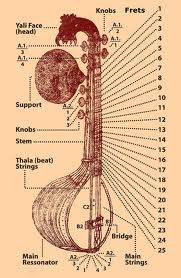
The Saraswati veena (also spelled Saraswati vina) is an Indian plucked string instrument. It is named after the Hindu goddess Saraswati, who is usually depicted holding or playing the instrument. s used mostly in Carnatic Indian classical music. There are several variations of the veena, which in its South Indian form is a member of the lute family. One who plays the veena is referred to as a vainika.


The veena is an ancient instrument dating back to Vedic times (1500BCE). The veena instruments developed much like a tree, branching out into instruments as diverse as the exotic harp-like Akasa (a veena that was tied up in the tops of trees for the strings to vibrate from the currents of wind) and the Audumbari veena (played as an accompaniment by the wives of Vedic priests as they chanted during ceremonial Yajnas). Veenas ranged from one string to one hundred, and were composed of many different materials like eagle bone, bamboo, wood and coconut shells.

The current form of the Saraswati veena with 24 fixed frets evolved in Thanjavur, Tamil Nadu, during the reign of Raghunath Nayak and it is for this reason sometimes called the Tanjore veena, or the Raghunatha veena. Prior to his time, the number of frets on the veena were less and also movable.

The veena is played by sitting cross-legged with the instrument held tilted slightly away from the player. The small gourd on the left rests on the player's left thigh, the left arm passing beneath the neck with the hand curving up and around so that the fingers rest upon the frets. The palm of the right hand rests on the edge of the top plank so that the fingers (usually index and middle) can pluck the strings. The drone strings are played with the little finger. The veena's large resonator is placed on the floor, beyond the right thigh. (Wikipedia)
Like the sitar, the left hand technique involves playing on the frets, controlled pushing on the strings to achieve higher tones and glissandi through increased tension, and finger flicks, all reflecting the characteristics of various ragas and their ornamentation (gamaka). Modern innovations include one or two circular sound holes (like that of the lute), substitution of machine heads for wooden pegs for easier tuning, and the widespread use of transducers for amplification in performance.

Chitti Babu (1936-1996) was one of the most famous Veena artistes of India, who had carved his place amongst the all-time greats who played that instrument. A man who became a Legend in his own Lifetime, his name was synonymous with the instrument "Veena", and he was and is still known in the Carnatic music world, quite simply as “Veena” Chitti Babu. While continuing with the principles of his Guru’s pioneering school - the Emani “Bani” (tradition/style), Chitti Babu, created and evolved a distinctive style and identity, entirely his own. The exquisite tonal quality and versatility that have been his magical hallmarks of his style of playing the Veena, saw him produce sounds as varied as the majestic Vedic Hymns or as delicate as the Cuckoo’s voice or even play many western-music based compositions of his own. He was known to reproduce the songs and compositions in an almost vocal like tonal quality on his Veena, and was also known to evoke deeply emotional and appreciative responses from his audiences. (http://www.veenachittibabu.org/id1.html)


More scintillating music from India.


         Track Listing:
01 Chalamela, Sudhamayi, Ksheera Sagara Sayana
02 Ragam Thanam Pallavi, Apadooruku, Nallani Vada, Mangalam (A Hymn from Vedas)
Listen here.