Showing posts with label Kenya. Show all posts

Monday, July 23, 2012

Pure Kenyan Gold: Extra Golden


A while back I posted Thank You Very Quickly by the American-Kenyan group, Extra Golden.  A few days ago I found their first album OK-Oyot System going for a song in yet another struggling retail outlet.  I grabbed it and have been listening to it all weekend. This is a record that places the electric guitar front and center, whether it be the languid plucking of shantytown Luo rhythms or elongated swathes of American stoner rock.  Sound weird?  Not at all. These guys work up an entirely pleasurable aural feast that ploughs a deep, but always gentle, groove.  That it was recorded in one afternoon session is a wonder to behold.

Some of the other sounds that came to mind as I listened: 3 Mustaphas 3, Black Keys, Cornershop!

Recorded in Kenya under a canopy of personal hardship, sacrifice, and loss, Ok-Oyot System has the type of compelling backstory that seems as though it should automatically translate into a powerful listening experience. The album is a collaboration between Otieno Jagwasi and Onyango Wuod Omari-- both members of the Kenyan group Orchestra Extra Solar Africa-- and Ian Eagleson and Alex Minoff of the D.C.-based group Golden. It's a collaboration that began when Eagleson went to Kenya for a year to conduct research for his doctoral thesis on benga-- a jazzy, guitar-centric strain of dance music popular in Kenya since the 1960s.

As guitarist and vocalist for Extra Solar Africa, Otieno provided much assistance for Eagleson's research; ultimately, Extra Golden were assembled in April 2004 to create and record their unique benga/rock hybrid. Along the way the musicians were forced to overcome numerous obstacles, including a costly run-in with the corrupt Kenyan police force and the effects of Otieno's severe physical ailments. Suffering from kidney and liver diseases that were complicated by HIV, Otieno's health continued to deteriorate after this recording session. He passed away in May 2005.
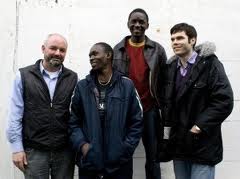

The title Ok-Oyot is derived from a Luo phrase that means, "it's not easy." This expression is used regularly as an exclamation in benga songs, and needless to say it seems a particularly apt descriptor for Extra Golden's all-too-brief collaborative experience. Yet considering the misfortune that seems to have plagued the album's creation-- and the political nature of some of its lyrics--the music on Ok-Oyot System is not particularly freighted with angry defiance, outward gloom, or self-conscious poignancy. Instead it's an album that sounds very much like what it is: Four talented, enthusiastic musicians playing together as a group for the first time, patiently working through ideas to determine a common musical vocabulary.

The bulk of the album was recorded in a single afternoon, a spontaneous approach that perfectly complements the exuberance of tracks like the opening "Ilando Gima Onge". In the hands of Extra Golden, benga seems an especially malleable genre, one that coarsely blends Indestructible Beat of Soweto propulsion with fluid, almost Cuban-accented rhythms and miles of complex, interlocking guitar figures. On the opener, Otieno adds some appealing, laid-back vocals, but the 11-minute song is dominated by the ambitious dialogue between his guitar and those of Eagleson and Minoff. Both the title track and the deceptively sunny anti-Bin Laden cut "Osama Rach" were written in the studio, held together primarily through Omari's agile, inventive drumming and the group's obvious sense of camaraderie.


            Track Listing:
            01 Ilando Gima Onge
02 It's Not Easy
03 Ok-Oyot System
04 Osama Rach
05 Tussin and Fightin'
06 Nyajondere

Wednesday, March 14, 2012

Of Exile, Joseph Kony and Alice: Geoffrey Oryema

Geoffrey Oryema

Joseph Kony is getting a lot of attention these days. Which overall, despite the objections raised in some quarters about the YouTube documentary’s accuracy, is a good thing. The more people who are aware of his history and existence the better. The more light, the less darkness.

About 20 years ago I was working for the United Nations in Kenya.  My job, as I’ve probably mentioned in earlier posts, was to find what were referred to as ‘durable solutions’ for refugees and asylum seekers from other African countries. As most would never willingly return home there were exactly two durable solutions for the United Nations to consider: a long spell in a refugee camp in the remote arid areas in the north of the country or, resettlement in a third country such as the USA or Australia.  The government of Kenya didn’t really care which solution was applied to the thousands upon thousands of refugees in the country, because both options didn’t cost them a thing. The international community paid for the upkeep of the camps and the plane tickets out the country.  Generally, their policy was to leave refugee matters alone.

So one morning I was surprised to receive an urgent telephone call from a senior official in the Security Department calling me to a meeting at their HQ the next day.  When I arrived I was escorted into an office and the doors were closed behind me. Several men who appeared to be very senior and very tough operators told me that the government had a highly sensitive case they needed the UN to get out of the country as quickly as possible.  “This person is a risk to the security interests of the nation,” I was told. “You must do whatever you can to resettle her, in any country we don’t care which one, immediately.”

I was informed that my boss had been briefed and approved of the ‘operation’ as they called it.  The following morning I arrived early at the Police HQ and was put into a police jeep with two officers and driven away.  We drove south toward Mombasa for a couple hours and then took a rutted dirt road for another half hour.  In the middle of the savannah sat a small cluster of concrete buildings. I was ushered into a small room where I sat with my back to the only window. A few uniformed constables stood to attention and after a few minutes a door creaked open and one of my police companions escorted in a diminutive middle aged woman. 

“This is Alice Lakwena,” the police man said and made sure she was comfortably seated. Then he stepped back away from the rickety table which stood between me and Alice.  Over to me.


For the next two hours I interviewed Alice. I had been given a report or two on her by my boss and during the drive down from Nairobi the police officers had told me more about her. 

Alice was a spirit woman. In the West we would have called her a witch. In some societies she would have been a shaman or oracle.  From a humble northern Ugandan background she was poorly educated and appeared to have no particular talents. But during the harsh civil war that followed the overthrow of the Idi Amin and Milton Obote regimes, Alice became possessed by the ‘holy spirit’ of Lakwena (the Messenger).  One of her first acts was to build an altar to the Lord in Acholi land upon which she sat and made grave prouncements. Menfolk scoffed at first. “How could God speak through a woman?”  But as is the wont of divine beings Lakwena made it clear to her friends that it was precisely because she was weak and insignificant that she had been chosen to do significant and powerful things for her people.

I can’t remember for sure but I think she spoke a broken but not too awful English. I pressed her on what she wanted, thinking that it was she who was asking the Kenyans to get her out of the country.  “The altar must be rebuilt,” Alice told me. That was her only demand. Her only concern. She cared nothing for the UN or resettlement. I figured out immediately that she was meeting me under sufferance. She only wanted to channel Lakwena’s messages to her people and lead them to victory. For that the altar needed to be rebuilt.

Like many similar African spirit women, Alice’s messages from Lakwena, attracted a large following. Many of her Holy Spirit Movement followers were young children, war orphans mainly but also kidnapped kids. She had convinced her soldiers that the Holy Spirit would not allow them to be killed in battle if they rubbed a certain ointment on their bodies. Stones would turn into exploding bombs and indeed, the Holy Spirit Movement experienced remarkable success in the field against the National Resistance Army, led by General (later President) Yoweru Museveni.

The interview was shambolic. Or at least her responses were. She seemed to drift in and out of a trance but it could have been that she was drugged. The Kenyans were nervous. A lot was happening in the neighbourhood at that time. Ethiopia and Somalia had collapsed and Uganda was making forays into Rwanda.  Museveni had according to the police, made it clear to the Kenyan government that he wanted Alice returned or sent far away from East Africa. A war with Uganda was not what the Kenyans wanted and so the call to my employer to get her out of the Kenya pronto.

Alice as I recall now, many years later, was slight and seemed very frail. But there was a definite aura about her. I can sense it even now. Her words were confused but her speech was powerful. In full flight the incongruity of such force coming from so frail a form would have been frightening indeed to behold.  When the NRA finally defeated her Holy Spirit warriors she fled to Kenya. Her holy army fell under the command of her deputy a certain Joseph Kony, who went on to terrorise the northern parts of Uganda and neighboring countries for many years.

Back in Nairobi I wrote my assessment which was that no country would willingly accept her as a refugee. And indeed, she had no desire to settle anywhere else but northern Uganda.  My boss informed the Kenyans of this assessment and so they excercised the only durable solution left, to house her in a remote refugee camp on the Somali border. There she lived for many more years until she died in 2007. Lakwena’s altar, as far as I know, was never rebuilt.

The music of Geoffrey Oryema is the voice of the exile. Himself an Acholi, he was a victim of the civil war that gave rise to Alice and Joseph Kony. His father was a minister in Idi Amin’s government but escaped to Europe as a refugee when the war began. Geoffrey has since settled in France but the music on this album Exile is haunting and very African. It is itself possessed of the spirits of Uganda just as Alice was. Though they possessed very different visions of their homeland, both spoke the language of the exile.


            Track Listing:
            01 Piny Runa Woko
02 Land Of Anaka
03 Piri Wango Iya
04 Ye Ye Ye
05 Lacan Woto Kumu
06 Makano
07 Jok Omako Nyako
08 Solitude
09 Lubanga
10 Exile

Listen here.


Tuesday, July 12, 2011

Rapid Gratitude: Extra Golden

Nairobi National Park
Extra Golden is a band of Kenyan and American musicians that combines good old guitar driven rock ‘n roll and Nairobi’s famous benga music. I love the name of this album and its cover art which together create the impression of being a cheaply produced pirate cassette of the variety that is found in any bazar, souk or market in any city in the developing world. Thank you Very Quickly (vol 3) a title that stumbles off the tongue is matched with a weird gaudy sunset snapshot. Basic graphics swirl boldly across the scene.


The origins of the band are in Nairobi in 2004 when an American PhD student, and a couple American and Kenyan friends, lay down some rhythms using pencils, drum tracks and a concrete slab. They like what they hear but don’t do much with it except keep it on their computer. A year later their Kenya friend dies of liver cancer. The two Americans (Ian and Alex) recruit Onyago Wuod Omari (a drummer in Orchestra Extra Solar Africa) and Opiyo Bilongo, an established Benga musician, to the cause and Extra Golden  is born.

They are an instant hit and tour extensively across the USA and in Africa.

Thank You Very Quickly (vol 3) is their latest.  I’ve included an extra  Extra Golden delight in the form of their tribute to Obama taken from a live radio show in the USA.  The mix of good old American rock guitar playing (at times sounding almost as if Duane Allman has risen from the Georgia clay) and the nimble dancing benga style is intoxicating.

         Track Listing:
1.     Gimakiny Akia
2.     Fantasies of the Orient
3.     Piny Yore Yore
4.     Anyango
5.     Ukimwi
6.     Thank You Very Quickly
7.     Obama (live)
Listen here.