Showing posts with label Oum Kulthum. Show all posts

Tuesday, April 17, 2012

The Mathematician of Nishapur: Oum Kulthum


Look not above, there is no answer there
Pray not, for no one listens to your prayer

Near is as near to God as any Far
And Here is just the same deceit as There.

Did God set grapes a-growing, do you think
And at the same time make it sin to drink?

Give thanks to Him who foreordained it thus

Surely He loves to hear the glasses clink!

The quatrains attributed to the medieval scholar from Nishapur in Persia, Omar Khayyam, are some of the most widely translated and revered in world literature.  Whether he wrote them all or just a few and what he meant as well as whether he was a mystic or a hedonist are all matters of debate.

But as you read them it is hard not to hear the music within.   

Here with a Loaf of Bread beneath the Bough
A Flask of Wine, a Book of Verse--and Thou
Beside me singing in the Wilderness--
And Wilderness is Paradise enow.

Think, in this batter'd Caravanserai
Whose Doorways are alternate Night and Day,
 How Sultan after Sultan with his Pomp
 Abode his Hour or two, and went his way.

And this delightful Herb whose tender Green
Fledges the River's Lip on which we lean--
Ah, lean upon it lightly! for who knows
From what once lovely Lip it springs unseen!

Oh, come with old Khayyam, and leave the Wise
To talk; one thing is certain, that Life flies;
One thing is certain, and the Rest is Lies;
The Flower that once has blown for ever dies.
There was a Door to which I found no Key:

There was a Veil past which I could not see:
Some little Talk awhile of ME and THEE
There seemed--and then no more of THEE and ME.
Then to this earthen Bowl did I adjourn
 My Lip the secret Well of Life to learn:
 And Lip to Lip it murmur'd--While you live,
 Drink!--for once dead you never shall return.

Alike for those who for TO-DAY prepare,
And those that after a TO-MORROW stare,
A Muezzin from the Tower of Darkness cries
Fools! your Reward is neither Here nor There.
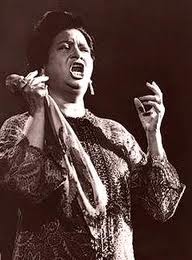
Oum Kulthum

Ahmed Rami an Egyptian poet translated Khayyam’s epic into Arabic and Oum Kulthum sang it.

Here it is. 

Enjoy (with a glass of wine!)


Track Listing:
01.  Robaiyet el Khayyam
02.  Hadith el Rouh

Listen here.


Wednesday, February 22, 2012

The Star and the Tuquoise: Oum Kulthum and Fairuz


The aural universe of the Arabic chanteuse is so distinct from that of South Asia. For someone raised on ghazals and sufi kalam both of which are performed with small ensembles of no more than two or three accompanists, the sweeping orchestral strings of the Middle East are at first blush over doing it. Even the-everything-including-the-kitchen-sink approach of Mumbai filmi senti-pop seems more simple and straightforward than even a small Cairo orchestra. 

I fully acknowledge that by making such statements I betray my bias. And un-trained ear. For years I’ve had friends wax on about the sublime Oum Kulthum but my South Asian ear has found it hard to find the golden thread.

Well as so often happens, things can suddenly change.  And so the big change has come to me. I’ve been listening to Oum Kulthum, Egypt’s (nay! the Arab world’s) Billy Holliday meets Begum Akhtar quite a bit recently and I am starting to get it.  Don’t ask me how. And don’t ask me to explain what it is I get, because my knowledge of Arabic is restricted to about 3 juicy and not for polite company phrases.  I just do.

Suddenly the waves of violins and dancing dumbek rhythms not only make sense but sound very pleasing. Their elegant sound is noble and befits the ancient lands from which they emerged. Oum’s voice is strong and the melodies different from those of the subcontinent. And perhaps that’s what makes is suddenly so nice. It’s different.

Oum Kulthum

So for your pleasure tonight I share two more albums. The first from the aforementioned Star of the East, Oum Kulthum: a live concert of unknown date but of timeless sound.  In it she sings one of her most beloved and famous songs Al Attal and is accompanied by a lively orchestra. 

Any number of sites on the internet or in music literature will give you lowdown on this icon’s life so I simply commend this magnificent music to you.

            Track Listing:
            01 Hayyarti Albi
02 Al Attal
03 Ana Fi Intizarak
04 Al Hobbi Koulloo
05 Anta Fen Wa Hobbi Fen
Listen here.

Fairuz

If Oum Kulthum is regarded the greatest female Arab voice of recent times, the Lebanese singer Fairuz (Turquoise, in Arabic) is considered the greatest living Arabic voice. The mother of Ziad Rahbani, previously spotlighted on Washerman’s Dog, Fairuz has a fantastic if slightly less heavy voice that her Egyptian inspiration.

Many of the tracks on this album are also from live performances and each once is worth many good listens, but my favourite is the amazing Ya Mina El Habayeb. Interestingly all the songs on this album refer to Arab capitals or countries.  And if you’ve spent  any time at all among Arabs you’ll understand just deeply they love their part of the world. 

            Track Listing:
            01 Beirut Hal Zarafat (Live)
02 Ya Mina El Habayeb (Live)
03 Amman
04 Al Kuwait (Live)
05 Hamaltu Beirut (Live)
06 Misr Adat (Live)
07 Baghdad Wal Chouarra (Live)

Listen here.