|
| Sufi musician |
Response to recent posts on Pakistani music has been enthusiastic. I am delighted that many readers are discovering this wonderful musical heritage and especially happy that these artists are finding new fans and audiences. A sad reality of Pakistan is that culture, whether in the form of classical music, film, literature, drama and visual arts has been more often than not been criminally neglected. At times actively destroyed.
Institutions that support or promote Pakistan’s rich culture are few and far between. Lok Virsa (National Institute of Folk Heritage) is an exception but even its archives are poorly managed and frustratingly inaccessible and meagre. Many of the artists profiled on Washerman’s Dog retired prematurely for a lack of an audience, venues and official support. Others, like Mohammad Tufail Niazi, Ustad Sadiq Ali Khan Mando and Ustad Nathoo Khan died in abject poverty, ignored and anonymous to all but a handful of people. Ironically, their legacy and reputation is better known in India and internationally, than in Pakistan itself.
Which makes this collection of recordings so valuable. All lovers of these posts should congratulate Shalimar Recording for their contribution to keeping the flickering embers of Pakistani art and culture glowing.
 |
| Amanat Ali Khan |
Ustad Amanat Ali Khan died in 1974 at the tragically young age of 42. Earlier that year he recorded the song of his greatest renown, Inshaji utho ab khooj karo. With a gamboling tabla conjuring a lilting bullock cart ride, the song is the final testimony of a world-weary man who is confronting his fate, but not with regret, and realizing he is now ready to ‘move on’ (khooj karo).
Inshaji, as the song is referred to, may be his final cri de cœur but it was but one single instance of brilliance from the (in the Dog’s opinion) the greatest singer in modern Pakistan. The list of ghazals that are forever associated with Amanat sahib is long and distinguished: Dil mein meethe meethe dard-e-phool, Hoton pe kabhi, Yeh arzu thi thujhe. One can only regret the great man’s early exit from the scene.
The grandson of one of the founders of the Patiala gharana of Hindustani khayal, Ustad Ali Baksh Khan, who was also known as Jarnail (the General). This unusual title was awarded to the great man by the militaristic Sikh maharajas of Patiala as a sort of Punjabi ‘knighthood’. The family’s roots were in the Punjabi city of Kasur, home also to other iconic talents such as Ustad Bade Ghulam Ali Khan and Nur Jehan. Amanat began singing at a young age and became known for performing with this younger brother Fateh Ali Khan. After Independence and Partition the brothers remained in what became Pakistan and gained respect and recognition as the torch bearers of the Patiala gharana. While classically trained, appreciation for this highly refined art fell quickly away and Amanat sahib turned to the ghazal a far more accessible and popular form of singing. He is remembered for his sweet, high toned voice, his cultured manner and an incredible collection of singing offspring who dominated the ghazal scene in Pakistan in the wake of his death.


Track Listing:
1. Dil mein meethe meethe
2. Honton pe kabhi
3. Aa mere pyar ki khushboo
4. Kabhi jo nikhat-e-zulf
5. Yaar ko mein ne
6. Ik khalish ko hasil
7. Yeh na thi hamari qismat
8. Ae dila hum howay
9. Maza jahen ke
10. Jo guzri mujh pe
11. Yeh arzu thi thujhe gul
12. Aksar shab-e-tanhai mein
13. Yeh gumbad-e-meenai
14. Inshaji utho, ab khooj karo
 |
Ustad Nathoo Khan
|
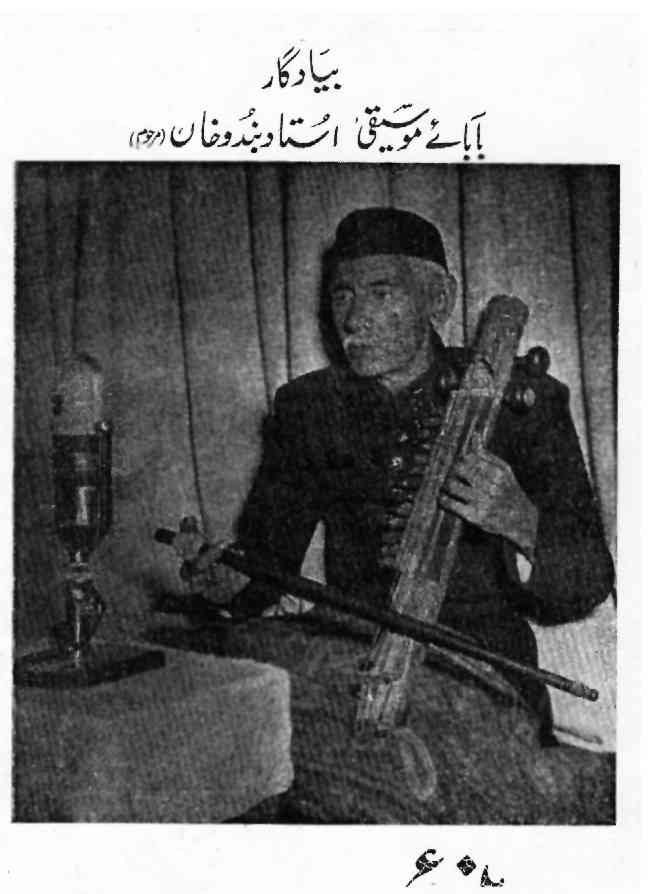
Ustad Nathoo Khan is regarded as one of the great sarangi players in the world. A malang by nature, Nathoo Khan was a man of few means, little formal training or education but great talent and soul. I copy a reflection on the great master, his instrument and the scandal of official neglect from a very useful blog, QAUL.
He was one of the artistes brought over to Radio Pakistan, Karachi, from All India Radio, by the Grand Old Man of Broadcasting, Z. A. Bukhari. Nathoo Khan was a malang, and his performances would reflect the must in his spirit. He would twitch and jerk along with every turn of musical phrase, creating a unity of body, soul and instrument—something that is achieved only by musicians like Zakir Hussain and Chaurasia these days.
Nathoo Khan was a permanent fixture at Radio Pakistan Karachi, lounging around the garden of the premises when he wasn't performing as accompanist, soloist or even time-segment filler. PTV in the earlier years (around 1965 or '66) did a documentary on him, showing him in his meager home, where he talked about his music and played his collection of various stringed instruments, all of which he handled with effortless mastery. It was one of the most memorable documentaries done by the stalwarts of PTV Karachi.
In order to get him his well-overdue recognition and improve his means, Omar Kureishi had him appointed to the PIA Arts Academy where he directed and composed a few orchestrals—not very memorable, most of it was the insipid music destined to be churned out over the airplane public address, to enhance the stupor of passengers. However he did compose a score for a dance ensemble that performed on stage in Karachi in quite a grand event. That was before breathing was deemed to be un-Islamic in Pakistan.
Omar wrote a piece on Nathoo Khan, in his reminiscent Dawn columns, 'The Past is Another Country' recalling a trip of the PIA Arts Academy to Geneva. They stayed at the Intercontinental, Geneva. Nathoo Khan's rather unkempt and threadbare appearance led the hotel staff to think that he was a menial, and they offered to feed him in the hotel kitchen. Omar, who was leading the delegation, went ballistic. Nathoo Khan ate at the regular restaurant and went on to enthrall the audiences.
The sarangi is one of the most complex instruments. While it has only three main strings, some thirty five to forty resonant strings provide it a unique timbre, and the older the sarangi, the better. Quite literally, a sarangi is considered coming into full song when it has been seasoned and played over a hundred years or so. The finger work is particularly difficult. Originally, masters of khyaal looked down on the sarangi and the sarangi-nawaz, as it was usual instrumental accompaniment to female singers, most of whom were courtesans. However around the thirties the tonal range of the sarangi was increasingly appreciated and made it the accompanying instrument of choice for the great masters of vocal Indian classical music. Nowadays the harmonium is more popular as it is much easier to play, and not as sensitive to variations in humidity and temperature. I dislike the harmonium. It is flat, noisy and tends to dominate the voice rather than augment it.
In the late eighties I attempted to collect Nathoo Khan's music in homage to his memory. It is a sign of our times and our assault on our cultural heritage that there was not a single recording that seemed to have survived in the Radio Pakistan archives. There must have been hundreds of hours of his music in that place. No one in PTV remembered the documentary that, like the audiotapes, was rerecorded over. (QAUL)
Track Listing
1. Raga Shudh Sarang
2. Raga Pat Deep
3. Raga Multani
4. Raga Madh Kauns
 |
| Hamid Ali Bela |
If you have spent any time at all around a sufi shrine you’ll recognize the sort of music Hamid Ali Bela sang: emotional, devotional and yearning. It is not the fiery fury of qawwali and not dissimilar (in spirit) to the Hindu bhajan. It is folk music and Bela’s repertoire derives from the kafi (sufi poetry) composed by the great spiritual personalities of Punjab and Sindh, Baba Ghulam Farid and Shah Hussein. This poetry is so deeply ingrained in the popular culture and consciousness of the people of this region of South Asia, you could say it IS the bedrock of the culture. Unlike Mohammad Tufail Niazi with whom Hamid Ali Bela shares a strong folk connection, this collection is entirely focused on spiritual themes. It is powerful, understated and tremendous music.
 |
| Shah Hussain |
Shah Hussain (1538-1599) was a Punjabi Sufi poet. He was born in Lahore. His tomb and shrine lies in Baghbanpura, adjacent to the Shalimar Gardens. His urs (annual death anniversary) is celebrated at his shrine every year. It is known as “Mela Chiraghan” (”Festival of Lights”) and is the second largest festival in Lahore after Basant. It used to be the biggest festival of the Punjab. Shah Hussain’s love for a Brahmin boy called “Madho” or “Madho Lal” is famous, and they are often referred to as a single person with the composite name of “Madho Laal Hussain”. Madho’s tomb lies next to Hussain’s in the shrine. Shah Hussain was the pioneer of the kafi form of Punjabi poetry.
Baba Farid (1173–1266) was a 12th-century Sufi preacher and saint of the Chishti Order of South Asia. He is generally recognized as the first major poet of the Punjabi language and is considered one of the pivotal saints of the Punjab region. Revered by Muslims and Hindus, he is also considered one of the fifteen Sikh Bhagats within Sikhism and his selected works form part of the Guru Granth Sahib, the Sikh sacred scripture.
 |
| Baba Farid |
One of Farīd’s most important contributions to Punjabi literature was his development of the language for literary purposes. Whereas Sanskrit, Arabic, Turkish and Persian had historically been considered the languages of the learned and the elite, and used in monastic centres, Punjabi was generally considered a less refined folk language. Although earlier poets had written in a primitive Punjabi, before Farīd there was little in Punjabi literature apart from traditional and anonymous ballads. By using Punjabi as the language of poetry, Farīd laid the basis for a vernacular Punjabi literature that would be developed later.
Among the famous people who have visited his shrine over the centuries are the famous scholar-explorer Ibn Battuta, who visited in 1334, and the Founder of Sikhism, Guru Nanak Dev, who met the then head of the shrine, Sheikh Ibrāhīm, twice, and his meeting led to the incorporation of 112 couplets (saloks) and four hymns by Bābā Farid, in the Sikh Holy Book, the Guru Granth Sahib, by the fifth Guru, Arjan Dev in 1604. Guru Nanak was familiar with the verse of Bābā Farīd, and not only includes these verses in the Holy Book, but even comments on some of them. These verses are known to the Sikhs as the Farīd-Bānī; Guru Arjan Dev also added eighteen saloks from the Sikh Gurus, which add commentary to various of Bābā Farīd's work.
The city of Faridkot bears his name. According to legend, Farīd stopped by the city, then named Mokhalpūr, and sat in seclusion for forty days near the fort of King Mokhal. The king was said to be so impressed by his presence that he named the city after Bābā Farīd, which today is known as Tilla Bābā Farīd. The festival Bābā Sheikh Farād Āgman Purb Melā' is celebrated in September each year, commemorating his arrival in the city. Ajodhan was also renamed as Farīd's 'Pāk Pattan', meaning 'Holy Ferry'; today it is generally called Pāk Pattan Sharīf. (Wikipedia)
Track Listing
1. Meay ni main kinon aakahan
2. Nayun la leya be parwah
3. Ronda moal nal soonda
4. Jeet wal menda mitr pyara
5. Sajan de hath baanh assandi
6. Menoon ambar jo aakhdi
7. Koi dam maan ley
8. Ni maaye moar je sakni
9. Ni tenoon rub na Bhali
10. Wey sanwla
11. Hik hey hik hey
The Washerman’s Dog will be off line for a week. Enjoy the music and see you soon.