Showing posts with label Jazz. Show all posts

Wednesday, May 8, 2013

Ready?: Freddie Hubbard


Freddie Hubbard

I played the trumpet or tried to, as a lad. While my efforts were pretty lame and abandoned pretty quickly, I still love the instrument.  Freddie Hubbard, one of the all time greats of the trumpet/flugelhorn is my favourite player of the bugle.  Tonight we share one of his all time great albums, from 1961, Ready for Freddie, about which AMG had this to say.

Trumpeter Freddie Hubbard really came into his own during this Blue Note session. He is matched with quite an all-star group (tenor saxophonist Wayne Shorter, pianist McCoy Tyner, bassist Art Davis, and drummer Elvin Jones in addition to Bernard McKinney on euphonium), introduces two of his finest compositions ("Birdlike" and "Crisis"), and is quite lyrical on his ballad feature, "Weaver of Dreams." Hubbard's sidemen all play up to par and this memorable session is highly recommended; it's one of the trumpeter's most rewarding Blue Note albums.

And this bio from the same source.

One of the great jazz trumpeters of all time, Freddie Hubbard formed his sound out of the Clifford Brown/Lee Morgan tradition, and by the early '70s was immediately distinctive and the pacesetter in jazz. However, a string of blatantly commercial albums later in the decade damaged his reputation and, just when Hubbard, in the early '90s (with the deaths of Dizzy Gillespie and Miles Davis), seemed perfectly suited for the role of veteran master, his chops started causing him serious troubles.
\Born and raised in Indianapolis, Hubbard played early on with Wes and Monk Montgomery. He moved to New York in 1958, roomed with Eric Dolphy (with whom he recorded in 1960), and was in the groups of Philly Joe Jones (1958-1959), Sonny Rollins, Slide Hampton, and J.J. Johnson, before touring Europe with Quincy Jones (1960-1961). He recorded with John Coltrane, participated in Ornette Coleman's Free Jazz (1960), was on Oliver Nelson's classic Blues and the Abstract Truth album (highlighted by "Stolen Moments"), and started recording as a leader for Blue Note that same year. Hubbard gained fame playing with Art Blakey's Jazz Messengers (1961-1964) next to Wayne Shorter and Curtis Fuller. He recorded Ascension with Coltrane (1965), Out to Lunch (1964) with Eric Dolphy, and Maiden Voyage with Herbie Hancock, and, after a period with Max Roach (1965-1966), he led his own quintet, which at the time usually featured altoist James Spaulding. A blazing trumpeter with a beautiful tone on flügelhorn, Hubbard fared well in freer settings but was always essentially a hard bop stylist.

In 1970, Freddie Hubbard recorded two of his finest albums (Red Clay and Straight Life) for CTI. The follow-up, First Light (1971), was actually his most popular date, featuring Don Sebesky arrangements. But after the glory of the CTI years (during which producer Creed Taylor did an expert job of balancing the artistic with the accessible), Hubbard made the mistake of signing with Columbia and recording one dud after another; Windjammer (1976) and Splash (a slightly later effort for Fantasy) are low points. However, in 1977, he toured with Herbie Hancock's acoustic V.S.O.P. Quintet and, in the 1980s, on recordings for Pablo, Blue Note, and Atlantic, he showed that he could reach his former heights (even if much of the jazz world had given up on him). But by the late '80s, Hubbard's "personal problems" and increasing unreliability (not showing up for gigs) started to really hurt him, and a few years later his once mighty technique started to seriously falter. In late 2008, Hubbard suffered a heart attack that left him hospitalized until his death at age 70 on December 29 of that year.Freddie Hubbard's fans can still certainly enjoy his many recordings for Blue Note, Impulse, Atlantic, CTI, Pablo, and his first Music Masters sets.


Track Listing:
01 Arietis
02 Weaver Of Dreams
03 Marie Anoinette
04 Birdlike
05 Crisis
06 Arietis (alt tk)
07 Marie Antoinette (alt tk)


Friday, April 26, 2013

Blue Birthdays: Ella Fitzgerald and Albert King


Ella and Albert


A couple of birthdays today.

Ella Fitzgerald and Albert King.

Happy Birthday to you!!!


Track Listing: (Ella Fitzgerald)
01 Jail House Blues
02 In The Evening (When The Sun Goes Down)
03 See, See Rider
04 You Don't Know My Mind
05 Trouble In Mind
06 How Long, How Long Blues
07 Cherry Red
08 Down Hearted Blues
09 St. Louis Blues
10 Hear Me Talking To Ya


Track Listing: (Albert King)
01 Don't Burn Down The Bridge ('Cause You Might Wanna Come Back Across)
02 I Believe To My Soul
03 For The Love Of A Woman
04 Blues At Sunrise
05 I'll Play The Blues For You
06 Little Brother (Make A Way)
07 Roadhouse Blues

Friday, March 22, 2013

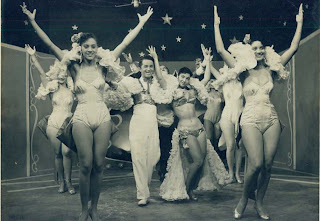
Friday Night at the Tropicana: Generoso 'Tojo' Jimenez


Havana, Cuba was Sin City for many Americans for the first half of the 20th century. Sugar barons, gangsters, dancing girls and spies haunted the clubs and bars along the the water front.  They say there were more Cadillacs per capita in Havana then anywhere else on earth. Night spots like Sloppy Joe’s, Floridita and the Tropicana were household names even in small town America.  The good times rolled faster and longer in Cuba than anywhere else in the world. It was a hoot, 24 hours a day.

And when it came to music Cuba gave the world the rumba, the chacha, son and all sorts of jazzy cocktails.  Music was everywhere. In the 5 Stars as well as in the dives. In the churches and in the streets.  Just as America was making Havana into its own little naughty off-shore play land, Generoso Jimenez, was born in Ceinfuegos, a town famous for producing numerous famous musicians.

He studied music with his father as a young boy and chose the slide trombone as his weapon of choice when he joined the local municipal band. He began developing his unique style in those early years because, the touring brass bands he played in had few trumpeters and it was left to the trombonists to do something ‘interesting’ during the breaks.

In Cuba all roads lead to Havana and soon Jimenez was playing the ‘bone in The Tropicana. The top shelf of American crooners--Sinatra, Nat King Cole, Cab Calloway--were regular performers and Generoso was always in the show band.  After hours he was a regular part of the jam sessions that could be found all over the city.  In the early 1950’s he joined a new band which was performing a new crazy rhythm called batanga, in which a new (to Cuba, if not to Latin America) vocalist named Beny More was the lead singer.  The following year, 1953, More, undoubtedly Cuba’s greatest singer, asked Jimenez, to manage his huge band as well as be the main music arranger.  In later years, he led the band for sometime before making his own records, two of which are highlighted tonight.


This release contains two sessions from the orchestra of Generoso Jimenez recorded several years apart. The first album [tracks 13-23] was recorded in 1960. [The record] includes exquisite versions of of such outstanding songs as Tono Fuentes’ Colombian ‘porro’ La mucura, performed ..in the Cuban guaracha style with some tasty grooves from the saxophone section and a magnificent solo by Chocolate Armenteros

Although Ramon Cabrera’s son A la Bahia de Manzanillo, was immortalized by Beny More, this instrumental mambo version gives the singer’s classic interpretation a run for its money with an exciting trumpet, trombone and sax duel.

This release, originally titled as Ritmo, includes first rate versions of La bamba with its typical rhythm from Vera Cruz; the rumba Senorita Luna with a loose arrangement; the Italian song Come prima, heard here in Havana’s cha cha cha style and many others.

The second session [tracks 1-12] was recorded in 1965 with another brilliant band. The first track is non other than the outstanding descarga (improvised jam based on a Cuban song) composed by Generoso and Rolando Baro entitled Trombon majadero. This is followed by the track  Descarga solfeando, another jam by the trombonist,  which contains a humorous interlude imitating a solfege lesson in the middle of the song. (Liner notes)

I’ve always been a sucker for good trombone playing and so commend these two classic Cuban jazz albums to you this Friday evening.

The sound of pre-revolutionary Havana!

Track Listing:
1-01 Trombón Majadero (Descarga)
1-02 Descarga Solfeando (Descarga)
1-03 Jaky Ky (Descarga)
1-04 La Rosa Roja (Chachachá)
1-05 Las Pilanderas (Descarga)
1-06 Ya No Me Quieres (Bolero)
1-07 Garabato (Descarga)
1-08 El Torrente (Mambo Chá)
1-09 La Vieja Rosa (Descarga)
1-10 Uno, Dos y Tres (Conga)
1-11 Llegaron del Otro Mundo (Descarga)
1-12 El Contrabajo Fantasma (Descarga)


2-01 La Bella Cubana (Chachachá) [feat. Cachao]
2-02 Come Prima (Chachachá) [feat. Cachao]
2-03 La Múcura (Guaracha Porro) (Featuring Cachao)
2-04 A la Bahía de Manzanillo (Son Mambo) [feat. Cachao]
2-05 Sueño de Amor (Chachachá) [feat. Cachao]
2-06 Cachita (Rumba) [feat. Cachao]
2-07 La Bamba (Bamba) [feat. Cachao]
2-08 Señorita Luna (Rumba) [feat. Cachao]
2-09 Besitos de Coco (Merengue) [feat. Cachao]
2-10 El Tambor de la Alegría (Tamborito) [feat. Cachao]
2-11 Maracaibo Oriental (Son Montuno) [feat. Cachao]


Wednesday, February 27, 2013

Music, Loyalty and Death: Moses Taiwa Mololekwa

Moses Taiwa Mololekwa


I claim no expertise or special insight into South Africa but I am very fascinated with its music, and from the comfort of a Lazy Boy, I enjoy hearing about its politics.  So, unlike my friend Phillip, who is very much an expert on matters South African (music and politics) and who is also responsible for introducing me to today’s spotlighted artist, I enjoy the protection of the novice, which means I’m to be forgiven for making sweeping generalisations and broad judgments.

And my first such generalisation is this: there appears to exist within the South African soul an equal capacity for creativity and destruction. For art and violence. Sure, this is true for most human beings and societies at some level. But the two forces of violence and artistic imagination seem to find a unique hospitality in South Africa.

This thought came to me as I read an article about Moses Taiwa Mololekwa, the pianist/composer who died a dozen years ago. A death, not of natural causes or illness, but of violence.

Here is the article from the blog Africa is a Country

Moses Mololekwa and the loss of “new” South African innocence
FEBRUARY 18, 2013 BY STEFFAN HOROWITZ
Recently, I’ve found myself listening to more and more South African Jazz. In particular, I’ve been gravitating towards the late pianist and producer, Moses Taiwa Mololekwa. Now, I must admit that my appreciation for Mololekwa’s music did not come about immediately and I fully acknowledge that his music is not for everyone (especially his inaccurately-labeled ‘fusion’ work), but there is certainly something magical and profoundly important about his work.


The reason I chose to write about this now is that last Wednesday marked the twelve-year anniversary of Moses Taiwa Mololekwa’s death at the age of 27. On the morning of February 13, 2001, Moses was found hanged next to his wife, who had evidently been strangled, in their office. The circumstances of their deaths are troubling, to say the least, yet this should not obfuscate the significance of Mololekwa’s contribution to South Africa’s already impressive musical legacy.

Predominantly active in the 90s, Moses Molelekwa’s music fused an eclectic mix of influences such as Thelonious Monk, Herbie Hancock, and Bheki Mseleku, among others. His compositions contain references to genres as varied as hip-hop, jungle, kwaito (in fact he produced a number of tracks for the legendary kwaito group, TKZee), and perhaps most notably, marabi. His ability to play around with and recontextualize marabi grooves was nothing short of spectacular and as such, his music should be considered the archetype or standard against which all bubblegum and crossover production and instrumental arrangement of the time should be compared. This is true more for albums like Wa Mpona and Genes and Spirits, than for his comparatively straightforward (yet equally brilliant) Finding One’s Self and Darkness Pass.

For many of those who listen to the former two albums today, the music may come across as rather kitsch. However, the sound Mololekwa crafted on albums like Wa Mpona and Genes and Spirits must be understood within a larger context. The particular moment in South African history in which Taiwa made his music was one of excitement and celebration, as the apartheid era officially ended and the popularity of the ‘new South Africa’ rhetoric reached its peak. From a musical standpoint, this was a moment of immense pride, where musicians were looking inward and trying to create sounds and aesthetics that were uniquely South African, thereby setting themselves apart from the rest of the world (people were attempting to define themselves largely in relation to their ‘South Africanness’). Hence, popular genres like kwaito and crossover emerged as this shift towards prioritizing and performing ‘new South African’ subjectivities picked up steam. To be clear, Mololekwa was not necessarily trying to create music that was uniquely South African in the same way that folks like Johnny Clegg and the Trompies were, but this sentiment and the sonic aesthetics of the time inevitably found their way into his compositions. In many ways, Moses Mololekwa’s music became emblematic of the ‘new South Africa’ and for some, his death signaled the loss of this ‘new South Africa’s’ innocence.

Today, it does not require much of a leap of the imagination to hear Moses’s influence when listening to much of the deep house music being produced by popular South African acts like Black Coffee and Culoe De Song.

What drives a man so full of talent and Spirit to kill his lover and himself? A man who is young and admired at that. What great darkness is so powerful as to extinguish one’s light with such finality?

There is a school of psychology and therapy which is founded on the belief that each individual belongs to a ‘system’ or more accurately, multiple systems; family, society, culture, class, country. And at an unconscious level she/he retains strong bonds of loyalty to the values of those systems and acts out what those systems demand. Healing is finally brought through awareness and consciousness. By consciously severing these bonds, one experiences liberation.

It seems as if many artists from South Africa (Oscar Pistorius, falls into this category, too. He’s an artist of the track) remain unconsciously but very loyally and mightily bound to the expectations of an apartheid society that was born and experienced in violence.  Art is never far from violence and death.

This recording is from 1997 when a 23 year old Moses Taiwa Mololekwa performed at the Nantes Fin de Siecle Festival. The music is thrilling. You can feel his talent and imagination. And at the end feel the sadness that he was unable to break the bonds of loyalty to a monstrous system.


            Track Listing:
            01 Biko's Dream
02 Matswale
03 Mountain Shade
04 Dance To Africa
05 Ntatemoholo
06 Spirits Of Thembisa