Tuesday, July 12, 2011

Cultural Exchange: Ravi Shankar and Yehudi Mehuhin

This album was one of the early attempts at blending eastern and western music and quickly became a classic, It was a record that was played frequently in our India home. It was enjoyed equally by a ‘cool’ elder brother who seemed to know everything about Indian culture, even how to listen to the sitar, and a father who loved western classical music.

Rather than rattle on, I copy an interesting reflection by the two great men on how they came together and forged one of the musical world’s most enduring friendships. This is taken from the English newspaper The Independent on Sunday in 1995.

HOW WE MET: YEHUDI MENUHIN AND RAVI SHANKAR

Sir Yehudi Menuhin, 79, is one of the world's greatest violinists. A Goodwill Ambassador for Unesco, he lives between London, Gstaad and Mykonos with his wife, Diana. They have three sons and one daughter. The Indian musician Ravi Shankar, 75, was born in Benares. The most famous exponent of sitar-playing in the West, he lives between New Delhi and California with his family
INTERVIEWS SUE FOX 
Sunday, 1 October 1995
Yehudi Menuhin
   

YEHUDI MENUHIN: When Diana and I were first invited to India in 1952, Delhi was an absolutely incredible place, teeming with life. There were hardly any cars, so women in beautiful saris spilled out on to streets filled with monkeys and oxen. Exotic birds flew among the trees. It felt so different from what we experience today, when most of us seem to live in a submarine where there is barely enough oxygen for everyone. In Delhi, years ago, we were enchanted. Both of us wanted to learn more about the culture, the way of life, and, of course, I was interested in the music.
We met Ravi when he was invited to play for us at the house of a friend. He told me he had heard that I was interested in yoga. As a form of exercise, it appealed to me because musicians who are always on the run need to unwind. Unlike swimming, yoga doesn't have to be done in a special place. It was something I could do anywhere and, most importantly, in a hotel room, safely near to my violin. Unlike tennis, I didn't need to make arrangements with any other person in order to do it. It was perfect.
Because of my experience of getting to know the Romanian composer and violinist Georges Enesco, whom I had met recently, I was psychologically prepared for a meeting of minds with a man such as Ravi Shankar, who is an immensely dedicated man of the greatest integrity. As a teacher, I know of no better. His total commitment to his art goes far beyond pure music making. For Ravi, all human activity eating, dancing, doing exercise is imbued with a symbolic value beyond approach, and therefore it is all, in its own way, like some divine offering. I have learnt from him something which I always instinctively felt that music is beyond human essence. When we are working together, we always burn incense, as an offering.
For a while we managed to go back to India every year, and one of the high points of our trip would always be the chance to be with Ravi. He is especially close to Diana and has a true Indian understanding of women which goes far deeper than any Western attitude. To Ravi, there is something sacred in the feminine presence. It is a joy now to see him, with his wife, Sukanya, and his daughter, Anoushka, living in a quiet, serene environment in Encinitas, California.
Anoushka is a hugely talented musician and it is with enormous pride that Ravi introduces her when she takes part in his concerts. Unlike some people who may think that it is a terrible responsibility to live up to a father who has such a phenomenal reputation, to me it is the greatest privilege that she has had Ravi's guidance.
I remember once, in India, just before we were due to have dinner with Pandit Nehru, showing Ravi what I knew (which in those days was not a great deal), and standing quite awkwardly after getting into one of the positions. Ravi then said he would show me a head-stand. Quite effortlessly, he stood on his head most elegantly just as someone came in to announce: "Mr Prime Minister, dinner is served." Over the years, Ravi has explained and taught me a great deal about the deep breathing techniques and concentration which are so important if you are to do yoga properly.
I was hesitant the first time that Ravi said: "You must play music with me," but I finally took the plunge and we locked ourselves away while he gave me lessons in the basic formation of the music patterns. I was extremely nervous at the thought of performing with him. The only time I have ever been as nervous was one Christmas when a BBC producer called to tell me that I would be playing jazz violin with Stephane Grappelli. "You love him," he said. "I do," I answered, "but I just don't know how to play jazz." Then I thought, well, maybe there is just one thing I could play the tango tune, "Jealousy". And that's what I chose. It was the start of one of the two great adventures in my life the other was with Ravi. I remember New York in 1965, when Ravi and I were locked in a room together working day and night for four days, preparing for a concert. I have been at concerts with Ravi when he has been on stage until three o'clock in the morning.
To be a great sitar player like Ravi requires enormous intellectual gifts as well as musical ones. It is perfectly possible for someone who I might describe as having no brain at all to sing so beautifully that whoever listens is utterly enthralled, but it is quite impossible for an idiot to play beautiful Indian music. An untalented sitar player has absolutely nothing to convey to an audience and so the sound he makes is totally boring.
In the 43 years of our friendship, Ravi and I have never had an argument. Certainly, there have been many exchanges of ideas, but there is simply no room in either of our lives for an argument. It saddens me greatly that since his recent bypass surgery, each time I see him he seems to look a little more fragile. But I'd never say to him, "My friend, you are working too hard." That would be impossible for Ravi, work is his life.

Pt. Ravi Shankar
RAVI SHANKAR: In January 1952, Yehudi Menuhin and his wife Diana came to India. Together with other well-known Indian musicians, I was invited to Delhi to the house of the director-general of India Radio, to play for Menuhin. Of course, I knew about him and was familiar with his music. In fact, we had already met in Paris when he was 17 and I was 13. At the time I was living in Paris with my brother, Uday, who was 20 years older than me. His company of Hindu musicians and dancers was based in Paris and we used to go back to India every second year. One day, Yehudi and his sister Hephzibah came to visit our house. Hephzibah accompanied her brother at the piano and even though I was still very young, I was overwhelmed by the sound he made. Yehudi couldn't possibly remember me from all those years ago, but I've never forgotten his playing. In those days, in the Thirties, he came quite often to my brother's home. It was a period in his life when Yehudi was very influenced by the composer Georges Enesco, who had become a kind of guru for him.
It was during that visit to India in 1952, when I was asked to play for him, that we were formally introduced. He was extremely interested in Indian music and from the moment we met, we clicked, both as musicians and as human beings. It was the beginning of not only a very great friendship but a learning and sharing of each other's work. After that first visit, Yehudi became more and more interested in Indian culture. He came back with Diana on many more visits to India in order to learn, absorb and understand our music. I know that he calls me his guru, but, to be honest, I find that quite embarrassing.
I remember once, in London in the early Fifties, that Yehudi was particularly excited about a composition by Wilhelm Furtwangler, who had written a piece based on an Indian melody in what we call a raga pattern a scientific, precise, subtle and aesthetic melodic form with its own peculiar ascending and descending movement. Yehudi talked to me about the piece, which he was anxious for me to play. I looked at it, and from a Western point of view the composition was very good; but as an Indian sitar player, I felt it was not proper for me to play because it was also, from an Indian point of view, quite childish. It was also written in Western notation which was difficult for me to read, so I asked one of my English students to translate it for me. Eventually, I decided that I would rewrite the piece but that I wouldn't change the raga. There is a saying in Sanskrit, "Ranjayati iti Ragah" which means: "That which colours the mind is raga." Through the rich melodies of our music, every human emotion, every subtle feeling in man and nature can be musically expressed and experienced. This is what Yehudi and I have shared over many years with our concerts and recordings together.
For him, just as it is for me, there is always the excitement of wanting to discover more about the past. "Where did this music come from?" is a question which interests both of us. This year we have experienced a most fascinating journey learning about the origins of gypsy music together.
Although our cultures and our music are so different, I have never found it a strain to be with him. Not even at the beginning. From that very first meeting, I realised that Yehudi was quite different from almost any other Western musician I knew. This is not a criticism, but many Western musicians are very uptight because Western music is very precise. It's not something you play, as it were, between the lines. Of course, confidence is extremely important for a performer but with a lot of musicians it is their ego, not just their confidence which stands out. Yehudi's humility is quite extraordinary. It's one of the things which has always impressed me about him.
For the first few minutes whenever we are together usually after a much too lengthy absence there are tears in my eyes and also in his. The whole world knows Yehudi as a very special human being, but to me he is just my dearest friend. Recently, though, he has been looking old and quite frail, but he is still driven like the devil. Actually, as far as work is concerned, my nature is the same as his, but I've had a couple of heart attacks and have had to slow down. If my wife didn't look after me the way she does, I would probably have dropped dead in the middle of a performance. I look at Yehudi's schedule and it's scary. He'll go to a meeting in Brussels during the day and perform in Paris that same evening. The following day he's off to Vienna, or the Gstaad Festival, or even South America. To me, it's extremely frightening and I don't know how he does it. Diana, his wife is a wonderful person but even she can't change him, and that worries me!

Any self respecting music lover should have this album in their collection.


         Track Listing:
01 Prabhati (Raga Gunkali)
02 Raga Puriya Kalyan
03 Swara Kakali (Raga Tilang)
04 Sonata No 3 in 'A' Minor, Op 25 (Enesco) - Moderato malinconico
05 Sonata No 3 in 'A' Minor, Op 25 (Enesco) - Andante sotenuto e miserioso
06 Sonata No 3 in 'A' Minor, Op 25 (Enesco) - Allegro con brio, ma non troppo mosso

Listen here.


Sunday, July 10, 2011

Hot and Spicy Chutney: Music of the Indian Diaspora in the West Indies

To bring this mini series on Indian popular music to a close the Washerman’s Dog jumps with great zest across the oceans to the Indian diaspora communities of the West Indies. 

Chutney, the name of this intriguing popular music genre is evocative of a delectable Indian spice and indeed, this is music whose lyrical themes and dance style are generally described as ‘spicy’ or ‘hot’. Chutney’s fieriness lies in the clever double entendres of the lyrics and in the fast repetitive rhythms played on tassa and dholak drums and the dhantal (an iron-rod percussion instrument beaten with a horseshoe shaped striker). Audiences dance to this music in carnival fashion.

There was no music known as chutney as we know it today before approximately 1970. There was simply “local music”. Like the name salsa, which emerged as an umbrella marketing term in New York to cover a range of Puerto Rican and Cuban music, chutney was initially used to describe Indian-Caribbean traditions which were just beginning to be performed publicly. Just as Tito Puente once declared “The only salsa I know comes in the bottle. I play Cuban music,” so, too, did James Ramsawak, one of the oldest singers in Trinidad, who taught many of today’s chutney singers, say, “Chutney is not a music. Chutney is spice.”
Sundar Popo, chutney superstar

Because of the carnival connection, chutney is sometimes described as the Indian soca, a reference to the lively Caribbean form rooted in soul and calypso traditions. But it is more than that. Chutney has developed mainly in Trinidad, Guyana and Suriname and has widespread popularity in those places in addition to contributing to the general music scene in the Caribbean. The instruments used and the places where these sounds are prominent give some clues as to the origins of chutney.  Basically, its music from the Caribbean with roots in Indian musical traditions.  You can still hear the influence of Indian folk and devotional songs in contemporary chutney and today’s chutney singers are influenced by the sounds produced by the Indian film industry.

The story of chutney’s  development begins with the arrival of Indians in the Caribbean in 1838, recruited there, like in Fiji, to maintain the colonial plantation system of sugar production. So there is an Indian connection that goes far beyond the name of this music. Since chutney has developed in the pluracultural contexts of the Caribbean, it displays a mixture of other influences including calypso, soca, reggae and rap. (extracted from Liner Notes)

If you know and like the bawdy music of the Mighty Sparrow and other Caribbean calypso artists, then you’ll love chutney. This is indeed a hot and spicy collection that will make you get up and dance. The lyrics sung in a creole of Hindi (mainly of the Bhojpuri variety) and English are funny and light hearted and came out of the tradition of women singing racy songs to the bride and groom at Indian weddings.

For more information on this amazing but little known genre of Indo-pop, check out the Blog: http://chutneyontheweb.blogspot.com/ .


         Track Listing:
        01 Fan Meh Paolourine (Homefront)
02 Dottish Boy (Sundar Popo)
03 Lotayla (Sally Edwards)
04 Butterfly (Boyie Basdeo)
05 Ragga Dulahin (Double D)
06 Dum Maaro Dum (Celia Samaroo)
07 Scorpion Gyal (Sundar Popo)
08 Chutney Rampage (Ajala)
09 Chutney Genie (Madian Ramdas)
10 Doo Doo Darling Dhulanie (Ramdeen Maraj)
11 Ta Ra Ra (Ian Singh)
12 Khirk Na Din (Cecil Fonrose)
13 Caura River (Anand Yankaran)
14 Trinidad Ka Bapujee (Jairam Dindial)

Listen here.

Friday, July 8, 2011

No Bhangra Please, We're Punjabi: Rabbi Shergill

Rabbi Shergill


There are two things to say right up front about tonight’s artist, Rabbi Shergill.  He is not a Jewish priest. And. He is does not play bhangra.  He is a Sikh from Delhi, which clears up the first point but makes the second point more intriguing. 

Bhangra, the Punjabi harvest dance, whose beat, rhythms and energy have made a rapid and seemingly effortless insinuation into Western pop and rap formats, has become synonymous with Punjabi music. To find a Punjabi, especially a Sikh and especially from Delhi, who is not a bhangra wala is indeed, enough to make one stand up and take note.

Rabbi (Gurpreet Singh) Shergill had a hellish road to success in the music world. He played in a band (Kaffir) in Delhi but his bandmates were more committed to corporate careers and the thing petered out. Record companies came sniffing but left without offering him a contract. Even Sony pulled out after making positive noises. He worked his networks for finance and patronage which he eventually got, only to find the rupees run out and the record labels collapse.  Finally, in 2004, in what at the time, might have seemed like an act of desperation for both parties, Phat Phish Records and the earnest guitarist agreed to terms and a record was recorded and released.

In a twist usually found only in fairytales, the record, Bulla Ki Jaana, went gangbusters with the title track, whose lyrics were composed by the 18th century Sufi from Sindh, Bulleh Shah, outselling all other non-film based songs in 2005.

Shergill’s music is inspired by the mysticism of South Asian Sufis but also the folk music of Punjab. His voice is a thing of beauty: as clear and as natural and as high as a mountain stream.  His guitar playing is commendable though he does call on the chops of some international friends when fiery solos are required.  In addition to the understated mega hit Bulla Ki Jaana, other tracks like Tere Bin, Ishtihar and Ek Geet Hijar Da reveal just how talented a musician and songwriter Rabbi Shergill is.

This record is a delight on so many levels not least because as wonderful as bhangra is, it is fantastically fresh to hear smart, folksy Punjabi pop that engages the mind more than the legs and arms. 


         Track Listing:
         01 Bulla Ki Jana
02 Tere Bin
03 Heer
04 Ishtihar
05 Totia Manmotia
06 Ajj Nachna
07 Gill Te Guitar
08 Ek Geet Hijar Da
09 Jugni
Listen here.


Thursday, July 7, 2011

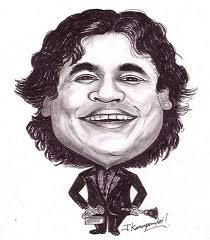
Stone Genius: A.R. Rahman

A.R. Rahman

From Hindi disco of the 1980s to Indian pop of today. 

The name A.R. Rahman is near enough to being of the household variety as any other out of Bollywood.  Most of his American and Australian fans only realised who he was when the triumphant anthem Jai Ho from Slumdog Millionaire climbed to the tops of the pop charts from Tucson to Tokyo. But the diminutive musical genius from the city once known as Madras (Chennai, these days) has been in the business of composing some of the most sophisticated pop music even before his ‘discovery’ by the Tamil film industry in 1991.

Born into a high caste Hindu family, Rahman’s parents were involved in the musical side of the south Indian film industry based in Chennai.  As a youngster, Dileep Kumar (his given name), accompanied his father to the studios and played various instruments on some of his compositions.  His father died when the boy was only 9 but he never considered any other profession than the one he had been exposed to by his dad.  In 1988, one of his sisters fell seriously ill and in spite of the family's effort to cure her, her health deteriorated. The family consulted a Muslim pir - Sheik Abdul Qadir Jeelani or Pir Qadri. At first blush, this seems an unusual step for a Hindu family, but when one considers Dileep’s mother had Muslim roots, a perfectly natural thing to do.  The holy man’s prayers and blessings saw the girl make a ‘miraculous’ recovery. In response Dileep, his mother and his sisters converted to Islam and the young boy took the name Allah Rakha Rahman.

Rahman’s musical journey saw him forming a rock ‘n roll band (Nemesis Avenue) with college friends  and recording his first album in English in the late 1980’s.  As is required of all artists, dues had to be paid, and Rahman worked in the jingle jungle writing musical ditties for companies pedaling everything from motorbikes and paint to breakfast drinks and watches.  

He spent time travelling internationally as a member of the great tabla player, Zakhir Hussain’s, band before returning to Chennai. When he won the local advertising industry’s top award in 1991 one of the Tamil film industry’s most famous directors, Mani Ratnam asked him to score his film Roja. In composing the song Tamizha Tamizha which became all the rage Rahman gave the public a  glimpse of the amazing fusion of pop, Western Classical, reggae, rock, and classical Indian music that would make him one of the world’s most imaginative composers. The film won him three awards for Best Music Director.

Since then he has simply dominated the film industry of India like no one before.  He has moved from the southern film industry to the mothership, in Mumbai, but continues to compose an amazing range of music for Indian and western audiences.  He has performed for President Obama, and with Michael Jackson and Mick Jagger. Andrew Lloyd Webber produced his musical Bombay Dreams, which ran to rave reviews for two years.  The accolades seem endless and yet from everything I’ve read or heard he remains a man of great humility. 

Baz Luhrmann, the Australian director, of such musical extravaganzas as Romeo and Juliet  and Moulin Rouge, sums up Rahman’s incredible talent:  I had come to the music of A. R. Rahman through the emotional and haunting score of Bombay and the wit and celebration of Lagaan. But the more of AR's music I encountered the more I was to be amazed at the sheer diversity of styles: from swinging brass bands to triumphant anthems; from joyous pop to West-End musicals. Whatever the style, A. R. Rahman's music always possesses a profound sense of humanity and spirit, qualities that inspire me the most.

I picked up this collection of his ‘Best’ from a friend in Kerala several years ago. The set is entirely from his Tamil and Malayalam films but the diversity, humanity and spirit that Luhrmann refers to comes through strong and clear.  I know three words of Tamil. But this is (honestly) one of my favorite records of the many thousands I am proud to own. 

If you know only his Hindi or recent music or if you know his music not at all, please dip in and discover. You will not be disappointed.


         Track Listing:
01 Baba Theme Music
02 Mustafa Mustafa
03 Shakalaka Baby
04 Kaadhalennum
05 Lucky Lucky
06 Sakhti Kodu
07 Velli Malare
08 Santosha Kanneere
09 Kaiyil Mithakkum
10 Rajyama
11 Kaadhal Vettukili
12 Muthalavanae

Listen here


Wednesday, July 6, 2011

Delhi Disco Fever: Sharon Prabhakar and Musarrat Nazir


Continuing in the vein of Indian pop music tonight’s post is a classic multi-country effort, Chal Disco Chal.  Produced by the UK’s Peter Moss and Kashmiri-Ugandan Deepak Khazanchi, this 1980 Hindi disco record brought together two female voices, India’s Sharon Prabhakar and Pakistani actress and singer, Musarrat Nazir.

The music is mainstream disco of the sort you might have heard in the nightclubs at the height of the disco era.  Though the songs are all in Urdu/Hindi there are no tablas, sitars or miscellaneous Eastern intruders here. You’ll find pulsating electric keyboards, funky slap bass, soaring sax and ripping guitar runs by (presumably) London-based session musicians.  The song titles sung with gusto and even at points some Donna Summer-esque moanings include such beauties as Diwana Hai Mera Dil (My Mad Heart), Mauf Karo (Forgive Me) and Main Teri Hun (I’m Your’s) in addition to the title track Chal Disco Chal (Let’s Go to the Disco). Dekho Dekho (Look Look) samples the Stevie Wonder riff Hotter than July, with not bad results.
Sharon
Sharon Prabhakar who was ‘discovered’ by the legendary (and subject of several Washerman’s Dog posts) Bollywood music director Bappi Lahiri, got her start as a singer while at college in Delhi. She sang in the big musicals of the era, Jesus Christ Superstar , Godspell, Evita  and Cabaret before hooking up with Bappi and making a series of disco and pop albums.
After several movies she essentially retired from the scene though appeared in the mid-90s as a TV host.
Musarrat
Musarrat Nazir is a Pakistani actress and singer who has starred in a number of important and popular Urdu and Punjabi movies, for which she has received a number of awards.  Part of the Pakistani classes that move regularly and comfortably between east and west, Musarrat has enjoyed performing careers in Pakistan as well as in the West.  She currently lives between Lahore and Canada.

Enjoy this slice of disco-India!


         Track Listing:
        01 Chal Disco Chal
02 Diwana Hai Ye Dil
03 Mauf Karo
04 Dekho Dekho
05 Daku Daku
06 Main Teri Hun
07 Mere Habib
08 Raja Aaja

Listen here.